How has the design of theatre buildings changed over time?
Early theatres
The first buildings used for theatrical performances in Britain were amphitheatres introduced by the Romans, who copied theatres from ancient Greece. These were semi-circular structures, constructed of wood initially and later stone. They were open to the air with banked seating surrounding a raised stage.
Medieval theatre was presented on elaborate temporary stages inside great halls, barns, or in the open courtyards of galleried inns. It was from these that Elizabethan timber-framed open-air theatres took their form, such as the Globe in London. They were often multi-sided buildings, with a covered platform stage against one side. The audience sat or stood in covered galleries around the other sides or in the open courtyard. All the performances took place in daylight.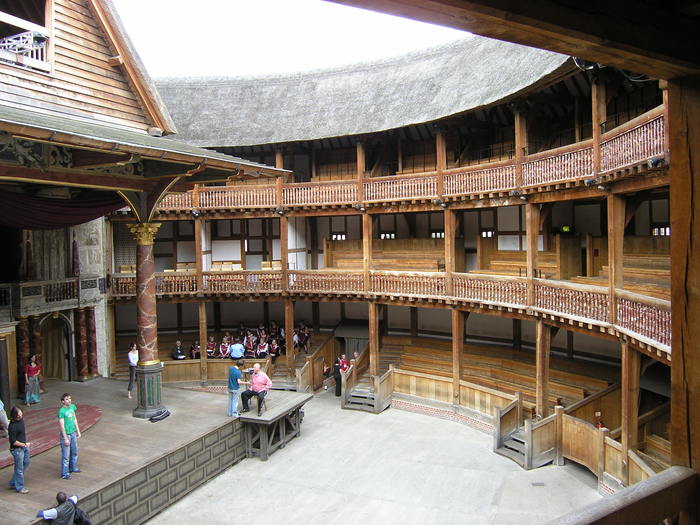 Shakespeare's Globe in London, a reconstruction of an Elizabethan theatre
Seventeenth-century theatres
Interest in theatre increased during the Stuart period. Many rich courtiers and aristocrats hosted touring theatrical productions in their homes. Masques too were a popular form of recreation for the royal court and the very rich, often commissioned for celebrations. They would involve music, dance and elaborate costumes and scenery. The architect Inigo Jones devised the sets for several royal masques, and later went on to design theatre buildings. He had toured Italy and France and was heavily influenced by their designs. He is also attributed with introducing the first proscenium arch – a decorative architectural frame over a thrust stage.
After the execution of Charles I in 1642, theatrical performances were outlawed owing to the threat of civil unrest. Theatres closed and many were demolished.
Following the restoration of the monarchy twenty years later, interest in theatre resumed. In reward for their loyalty to the Crown, Charles II issued patents to two theatre companies in London, Davenant and Killigrew, to stage drama. They presented at various sites across the city before they set up permanent theatres in Drury Lane and Covent Garden. Later, the King issued limited patents to a few more theatres in London. However, by this time, theatre buildings began to change, influenced by those in Europe. They were now roofed, with stages for changeable scenery that was slid into position using grooves in their floors. Other scenery was flown in from above. To accommodate these elaborate stage sets more space was needed behind the stage.
Eighteenth-century theatres
The Licensing Act of 1737 tightened censorship of drama, placing it under the control of the Lord Chamberlain. Only patent theatres were able to perform drama – known as legitimate theatre. Non-patent theatres performed melodrama, pantomime, ballet, opera and music hall (burlesque). As these involved music or musical interludes they could not be classed as plays and were regarded as illegitimate theatre so were not subject to the Licensing Act.
Later, a series of royal patents were granted to cities outside London. These became known as “Theatres Royal”. Many still operate and were built in a restrained neo-classical style.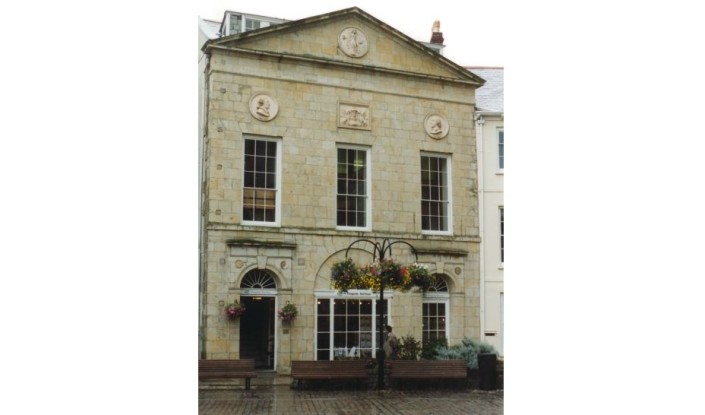 Façade of the former Theatre Royal, Truro
Also in the eighteenth century, companies of players began to travel on regular circuits between market towns. They set up their own theatres, called playhouses, which were similar in shape and size. This enabled stock scenery to be easily erected and reused, which made touring easier. Hundreds were built, of modest size and exterior. Their interiors were simple, consisting of a rectangular flat-floored room with a stage that projected into the audience. People sat on benched seating on the floor in front of the stage, or on balconies against the three remaining walls supported by columns or wooden posts. Any scenery was placed at the rear of the stage. The rich could pay a little more in order to sit on the stage, not only for better viewing, but also to be seen by the rest of the audience and the cast. These theatres were open for limited periods, and when not needed for performances could be used for other functions, for example as assembly rooms or ballrooms.
Theatres had mainly wooden interiors which were always at risk of fire. In 1794 the Drury Lane Theatre, London introduced the first iron safety curtain, which would eventually become a statutory requirement in all large theatres. It also had a large water tank on its roof – a feature that was adopted by other theatres – to extinguish fire in the stage area. The theatre also began to make its scenery more fire-resistant.
By the end of the century the façades of many city theatres were built in the more imposing classical style. Some even had porticoes, similar to those seen on the front of large city homes or country houses. They were added mainly for show, but a few enabled the rich to descend from their carriages and enter the theatre without being exposed to any inclement weather.
Nineteenth-century theatres
In the early 1800s, theatre attendance lessened, owing partly to economic decline and poor standards of acting and production. Patronage by the middle classes also fell as a result of theatre’s increasingly bad reputation and raucous nature. Consequently, many theatres closed or were converted to other uses.
The Industrial Revolution saw many people from the country migrate to the expanding industrial towns. This resulted in the decline of rural theatres, although some touring companies around the country continued to operate, but mainly from barn fit-ups. However, in the more populated urban centres there was a significant increase in theatre building.
In 1843, the Theatres Act removed the patent monopoly and allowed the Lord Chamberlain to grant a theatre license to any suitable person. This encouraged the building of new theatres, invariably by speculators seeking profit. However, the Lord Chamberlain’s new licenses forbade the consumption of alcohol in the auditorium. This led to the closure of many small saloon theatres, which relied upon alcohol sales to stay in business.
Yet, the same legislation enabled magistrates to grant public houses licences to offer a variety of entertainment, which led to the creation of a new form of popular theatrical entertainment known as music hall. Very soon, concert or supper rooms were built onto public houses which could sell alcohol and serve meals during their musical productions. They were usually well-lit rooms with a flat floor and a simple open platform stage with little or no scenery. The audience would sit on benches or at tables in front of the stage, or on balconies against one or more of the walls. They could come and go freely during the evening and were not restricted to performance times.
Eventually, a specific type of theatre building was developed to cater for this new form of entertainment, called a music hall. They had fewer tables in front of the stage, using the space for benched seating to accommodate more people. Hundreds were built in working-class areas as money-making concerns.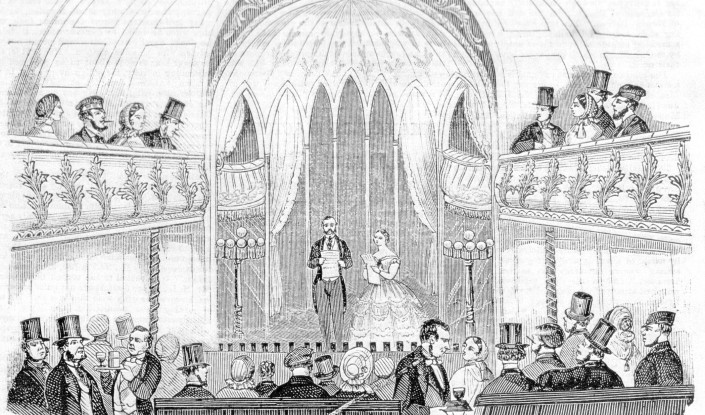 Etching of Wilton's Music Hall, London
By the middle of the nineteenth-century theatre building was becoming a specialist architectural discipline, led by architects such as J. T. Robinson and C. J. Phipps. They were tasked with building even bigger theatres, with grander front of house arrangements and more luxurious social areas.
Often, older theatres were demolished and rebuilt to accommodate larger audiences. In the auditorium, rectangular galleries began to be replaced by horseshoe-shaped balconies that enveloped the stage and provided better viewing.
The intention was to bring respectability to theatre-going and make it more socially acceptable for the middle classes. To achieve this, different classes were segregated: financially by the cost of the tickets; and physically by the requirement to use separate entrances and exits and circulation routes. The rich entered via illuminated entrances, with grand staircases and rich carpets: the cheaper seats via smaller side or rear entrances, with less grand staircases and public areas. Also, the benched pits in front of stages were replaced by more comfortable seats and carpeted aisles for the rich. The cheaper seats were now restricted to the rear stalls behind a wooden barrier, known as the ‘pit’, and the balcony or gallery.
Although theatre was enjoyed by much of the population, it was not always accessible throughout Britain. In rural areas of Wales the portable theatre was popular. These theatres toured the country and could be dismantled and moved easily. They were well supported in the small towns and villages which could not sustain permanent theatrical venues, and lasted until World War I.
Victorian invention and legislation
The Victorian period saw a number of innovations that impacted upon theatre design. Lighting changed from candle to gas and then later to electricity as a result of stringent health and safety legislation. Both emitted a more brilliant light that enabled directors to use lighting for theatrical effect.
Further legislation required that audiences seated at all levels could be evacuated quickly and safely in the event of fire or panic evacuations. Most theatre interiors used a lot of wood, including seats, balconies and structural supports. At that time the average life of theatres was just under twenty years owing to the risk of fire. Tragedies such as the fire at the Theatre Royal, Exeter in 1887, in which more than 190 people lost their lives, led to more careful planning of new theatres or the refurbishing of older ones. Fire exits and escape routes became a statutory requirement.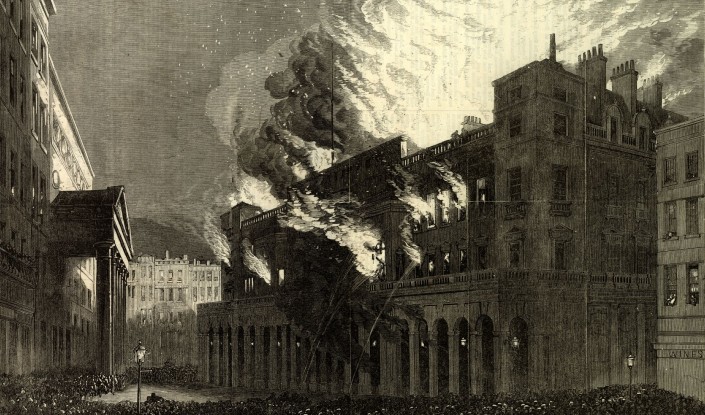 Sepia illustration of the 1867 fire at Her Majesty's Theatre, London
The development of cantilevered balconies was another innovation. These steel-framed structures covered with concrete did not need supporting columns that impede the audience’s view of the stage. Concrete soon became a popular material for theatre interiors, not only for its resistance to fire, but also because it could be moulded into elaborate curved forms.
Seaside and circuses
The expansion of the railways in the nineteenth century enabled urban populations to travel to the coast. These visitors liked to take in the sea air, promenading along the sea front and the lengthy piers that stretched ever further into the sea and which were being built in greater numbers from the 1860s.
Several of these commercial enterprises had theatres or variety halls built on them, and became an important element of the local seaside economy. Following the outbreak of World War II, though, many began to be neglected, and by the 1960s changing holiday patterns and rising costs led to many being closed, to be replaced by lucrative amusement arcades.
Hippodromes or circuses, too, were a popular form of entertainment in the Victorian period and developed from the interest in equestrian entertainment in the late-eighteenth century, which took place in circular enclosures. They were built in major cities and seaside resorts in theatre-like buildings to present live animal acts, though their shows would often include human acts.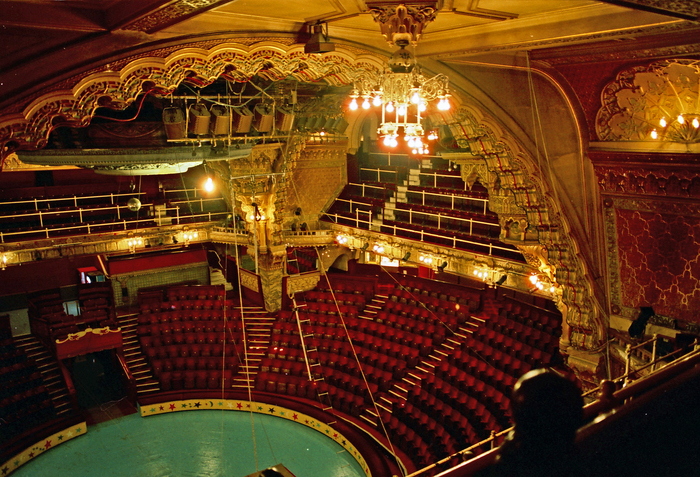 Tower Circus, Blackpool
Some hippodromes could even be flooded for spectacular water shows. Very few remain in use today, most converted to other uses or demolished, but they can often be recognised by the use of animal forms in their decoration.
Theatre-building’s heyday
The period from the 1880s to World War I was the greatest era of theatre building. Over 1000 professional theatres were operating in Britain then, some built by syndicates, who created chains of touring houses. New architects such as W. G. R. Sprague and T. Verity became renowned for their work and could design theatres according to the changing stringent building regulations.
Probably the most prolific was Frank Matcham, who designed or renovated over 120 theatres. He was noted for his excellent planning and opulent interiors.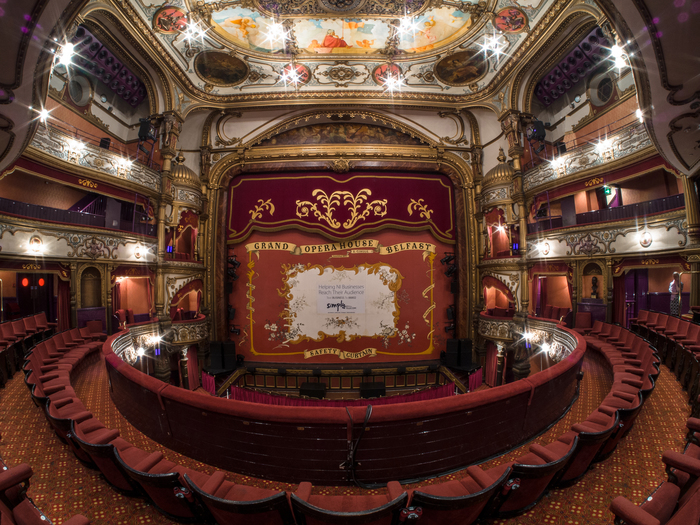 Frank Matcham's Grand Opera House, Belfast
The development of hydraulic (water powered) stage machinery enabled more spectacular productions to be presented. Shows with increasingly ambitious special effects were devised to attract and retain audiences. However, this required more backstage space for storage and operation.
Music halls were still very popular places of entertainment, but were usually called variety theatres, owing to the variety of the acts in their shows. To make them more suitable for families the consumption of alcohol was banned in the auditorium, though it could still be consumed in bars at intervals or before and after performances. Internally, they became more like conventional theatres. Admission was by payment for designated seats, as had been the case with theatres showing drama, and which ensured that families could sit together.
Early twentieth-century theatres
The beginning of the twentieth century saw the introduction of a new component in variety bills that would eventually lead to the closure of hundreds of theatres and music halls. This was the bioscope, a forerunner of the cinema. It was so popular that new or refurbished theatres often included provision for screening films.
The films were silent, but accompanied by music, usually an organ. These theatres became known as ciné-varieties, because of their mixture of variety theatre and cinema. Some foresighted architects included a separate projection room in their plans. This ensured the survival of some theatres as future fire safety legislation required any building showing a film to have a separate projection room. However theatres which relied on cinema for their commercial survival, soon closed if they failed to meet new regulations.
World War I suspended theatre building, but by then it had reached a peak and demand was satisfied. By then, large towns might have two or three theatres while cities could have up to a dozen. The Depression further affected theatre-going and theatre-building. However, it was the emerging popularity of film that concerned theatre owners. Super-cinemas were springing up rapidly, many designed in a radical new artistic style, known as art deco or ‘the Hollywood style’. This in turn influenced the refurbishing of some new theatres, which aspired to a more ‘moderne’ appeal, that of glamour and glitz.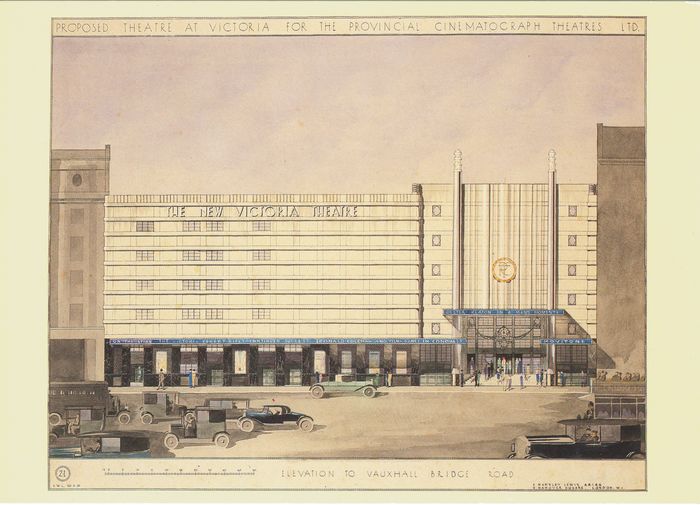 Proposals for the New Victoria Theatre (now the Apollo Victoria) in London, 1928
Either side of World War I there were some significant new developments in theatre. Club theatres were set up in response to the conservative nature of commercial theatre. In order to escape censorship by the Lord Chamberlain they operated as private clubs with ‘members’ paying a subscription fee rather than an entrance fee. These theatres were tiny and showed specialist, political and experimental theatre, as well as showcasing the work of foreign writers.
Also, the emerging Labour Party sought to raise the educational level and opportunities of the working classes through cultural activities. This led to the creation of theatres such as the People’s Theatre, in Newcastle upon Tyne, in 1911.
The period between the two world wars was one of social discontent, and saw the rise of the Workers Theatre Movement. It used theatre as a way to advocate social change and educate the masses. One of its achievements was the opening of the Unity Theatre in London in 1936, in a reused chapel.
A further initiative at the time was Repertory theatre, or ‘rep’. It evolved in the regions and was sponsored by rich theatrical benefactors seeking to introduce audiences to a wide variety of theatre at a price they could afford. These sponsors also sought to support local writers and help train young regional actors. Some ‘rep’ companies took over existing theatres, with assistance from their sponsors.
World War II and after
During World War II, CEMA (Council for the Encouragement of Music and the Arts) was set up to provide entertainment for the civilian and military population, often in community or church halls or in makeshift theatres in camps. This initiative, and subsequent interest in the arts as a whole, led to the formation of the Arts Council in 1946 which enabled public money to be used to support theatre in the regions, including the construction of new theatres. The Belgrade in Coventry was the first purpose-built theatre after the war.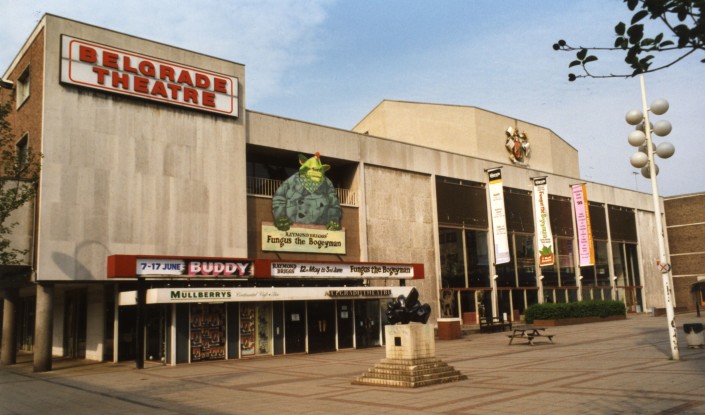 Belgrade Theatre, Coventry
After World War II, it was television that led to the demise of theatre-going. By then many older theatres were seen as old-fashioned and did not appeal to the modern lifestyle of the working classes. Falling audiences and increasing maintenance costs resulted in the demolition of many theatres, especially if they were situated in bomb-damaged town centres that were targeted for redevelopment. Others were converted to different uses, such as bingo halls or nightclubs.
In the 1960s and 70s, local councils were the main builders of new theatres, usually as part of their cultural and leisure programmes. Any new or replacement theatres were often integrated into multi-purpose civic complexes that included other amenities such as libraries, museums, sports halls, swimming pools and shopping areas.
These new ‘civic theatres’ were frequently designed for multi-purpose use and built in a more functional architectural style. They presented opportunities to experiment with different auditoria arrangements, with some being built in the less traditional arrangements, such as theatre-in-the-round, courtyard-style or with a wide single rake of seating and open stage.
In 1968 censorship ended, and performances usually seen in club theatres could now be staged in mainstream theatres. There was also an explosion of fringe and alternative theatre. Some companies acquired and adapted redundant buildings for rehearsal and presenting.
Concern over the number of older theatres being lost led to moves to preserve, restore and re-use theatre buildings. Finally, some were listed during the 1970s for their architectural or historical interest.
Then, in 1976, the Theatres Trust Act was passed, founding a new organisation, Theatres Trust, the National Advisory Public Body for Theatres, tasked with protecting theatres and theatre use, and with a statutory role to advise on all planning applications affecting land on which there is a theatre.
Further good news for theatres came in 1994, with the creation of the National Lottery. Its proceeds fund substantial ‘good causes’, including the restoration, refurbishment and redevelopment of theatres.
Then, as the millennium approached, towns and cities were looking at ways to celebrate the new millennium. Many opted for cultural initiatives, creating new performing arts venues, drawing on the financial opportunities offered at the time. This new breed of cultural centres provided the focus of much-needed urban regeneration schemes, creating accessible ‘landmark’ buildings for everybody’s use and enjoyment.
Images: Ian Grundy, Theatres Trust.