Imperial Theatre
A rare example of a theatre derived from an agricultural hall of 1869, which has retained its original architectural character.
- Address
- Darwall Street, Walsall, WS1 1DA
- Risk Rating
- 5 (Community Rating: 1, Star Value: 2, Risk Factor: 2)
- Local Authority
- Walsall Council
- Owner
- Private
- Architect
- G B Nichols of West Bromwich, remodelled by Hickton & Farmer
- Date of Construction
- 1868 - 69, substantially altered 1914
- Listing
- Grade II / Walsall Council Local Heritage List
- Capacity
- 1,150
Significance
The Imperial started life as an agricultural hall, constructed in 1868-69, and was designed by the architect G B Nichols of West Bromwich. At that time, it was used for a variety of community activities including shows and dancing and was also hired out to travelling film showmen. The main feature of the early building was a principal ground floor hall.
In 1880, the hall was reconstructed internally for use as a theatre, undergoing many alterations and improvements including the addition of a horse-shoe gallery, a new proscenium arch, and remodelling of the stage and back-of-house dressing rooms. From 1899 it was known as the Imperial Theatre and was used by professionals and amateurs.
By 1908, films were being projected by Bioscope on a regular basis. In 1909 the Cinematograph Act was passed, a principal feature of which was fire safety and the need for a separate, fire-resistant projection box connected to the auditorium by shuttered projection portholes. This led to the Imperial closing for major alterations in 1914. The designs by West Midlands-based architects Hickton & Farmer importantly still allowed for live performance. The conversion including an extension to the fly tower to provide a fully equipped stage with flying facilities. A balcony was also added, and the capacity increased to 1,600.
The Imperial was converted to a bingo club in 1968 and in 1996 it was converted into a pub, which closed in 2016.
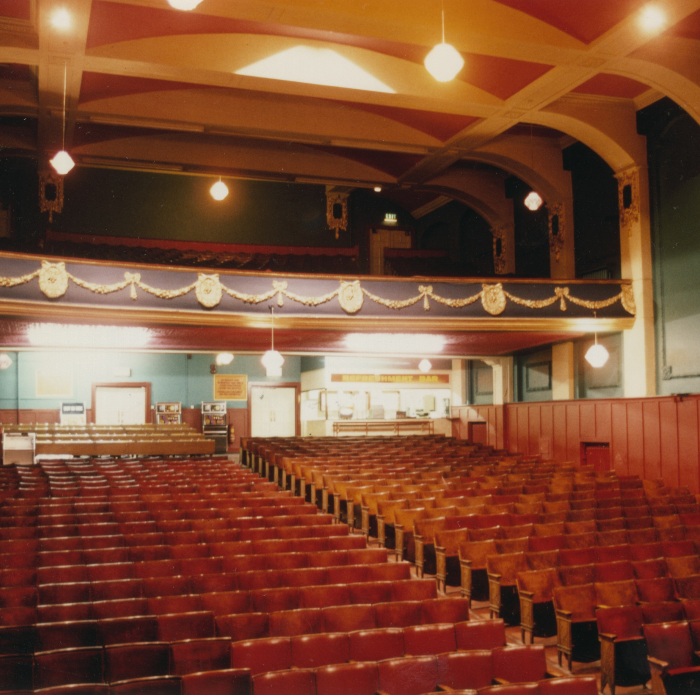
The theatre’s auditorium appears to retain the original roof and arrangement from the agricultural hall. It features open plastered roof trusses and lanterns above. Internally the 1914 decorative scheme survives with a good degree of preservation; later fit outs have simply covered over the original features or left them exposed. The main façade is also from the 1914 remodelling.
The Imperial is included on Walsall’s local heritage list. Theatres Trust successfully applied to have the theatre listed, with it being awarded Grade II listed status in January 2022.
Why is this theatre at risk?
The Imperial was added to the Theatres at Risk Register in 2022.
The theatre has been empty since the pub operator vacated in 2016. In 2021, its owner submitted a planning application to convert the theatre into 21 apartments with new window openings inserted. The conversion would have seen the complete loss of its 1914 interior and harm to its exterior, although the front façade would be retained. The proposal constituted harmful and irreversible alterations that would permanently remove any possibility of its retention for performance or other compatible use. Theatres Trust, along with the Cinema Theatre Association and the Victorian Society, submitted a strong objection citing harm to a non-designated heritage asset and lack of evidence to justify the loss of a community and cultural facility.
The Imperial has since been listed Grade II. The owner subsequently submitted a listed building consent application in August 2022 for the proposal to convert the theatre into 21 apartments. Theatres Trust, along with Historic England, the Cinema Theatre Association and the Victorian Society, objected to the listing building consent application. Walsall Council’s conservation officer also objected to both applications.
Both planning permission and listed building consent were refused in November 2022. The owner subsequently put the building on the market with a guide price of £595k. It failed to sell and its listing was taken down. More recent conversations between Theatres Trust and the owner have indicated that they would be open to considering returning the building to live performance use. Theatres Trust has offered to support the owner in this work. However, there has been no further confirmation that this will happen. Despite being vacant since 2016 the theatre remains in good condition both internally and externally, however, the longer the Imperial remains empty the more vulnerable it is to deterioration.
Theatre potential
Although there have been alterations to facilitate bingo and pub use, the auditorium is substantially complete and could be reverted to cinema or theatre use, or alternative uses sympathetic to its historic significance. The theatre is located within the town centre of Walsall, and Walsall’s Town Centre Area Action Plan seeks to strengthen its cultural offer, including providing cinema and performance venues.
In 2021, it was announced that Walsall Council had been successful in its bid to the government’s Towns Fund, an initiative aimed at transforming the economic growth prospect of towns. While the Imperial provides an obvious site that has the potential to meet these aims and we have encouraged the council to explore the opportunities that it presents, ownership remains a challenge.
With funding from the Architectural Heritage Fund, UK Culture Trust commissioned a viability study in 2024, which indicated that there was the business potential and local demand for the theatre to be returned to live performance use.
Current situation
Theatres Trust has been actively involved in helping protect the Imperial through our role as a statutory consultee in the planning process and through achieving listed status for the building.
We have been in touch with several interested parties who have ambitions to see the theatre reopened for live performance. We are supporting these groups through advice on early-stage viability work with the aim of unlocking a means to restoring and reopening the Imperial.
We will also continue to look to work with the owner, council, and other key stakeholders to take a collaborative approach to finding a viable and sympathetic reuse for this rare and important historic theatre.
Main photo, Imperial Walsall by Theatres Trust