Burnley Empire
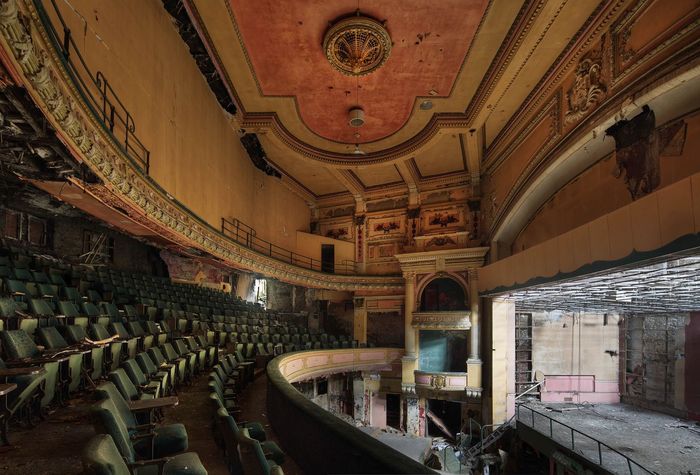
Burnley’s only Grade II listed purpose-built Victorian theatre. The auditorium was reconstructed in 1911 by eminent theatre architect Bertie Crewe and survives in its original, elaborate form.
- Address
- St James Street, Burnley, Lancashire, BB11 1NL
- Risk Rating
- 7 (Community Value: 2, Star Rating: 2, Risk Factor: 3)
- Local Authority
- Burnley Borough Council
- Local Group
- Burnley Empire Trust
- Owner
- Burnley Empire Trust
- Architect
- G B Rawcliffe, Bertie Crewe
- Date of Construction
- 1894
- Listing
- Grade II
- Capacity
- 1,200 (estimated)
Significance
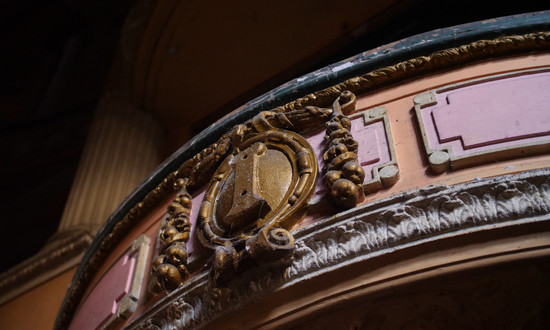
The 1,200-seat Burnley Empire was built in 1894, with the auditorium reconstructed in 1911 by Bertie Crewe. It is Burnley’s only Grade II listed purpose-built Victorian theatre. It has a high level of architectural interest, the principal feature being the Crewe interior. At the time of statutory listing, it retained most of the original structure and elaborate detail with robust and richly formed plasterwork in the classical style. Although in poor condition, the theatre could be restored for use. Research has recently revealed that the theatre hosted the first-ever film featuring escapologist Harry Houdini, adding further to the building’s cultural significance.
In 2023, and as part of Historic England’s work with the High Street Heritage Action Zone, the listing description for Burnley Empire was updated. Read the research compiled by Dr Elain Harwood.
Why is this theatre at risk?
Burnley Empire has been on the Theatres at Risk Register since 2006 when we started the Register.
Empty since 1995 when bingo moved out, by 1997 the disused upper level showed signs of significant water penetration. Over time the ownership of the building had been split, and the dressing room block, the main entrance foyer, and the linking block between the foyer and auditorium were sold to different parties, with the auditorium and stage house eventually falling under the jurisdiction of the Duchy of Lancaster.
In 2018, despite vigorous objections from Theatres Trust, planning approval was granted for a permanent café / bar within the original foyer of the building (118 St James Street). This decision highlights the complications arising when the ownership of a listed building is held by different parties and the historic significance of the different areas of the building are not fully understood.
In December 2018, local campaign group Burnley Empire Limited (now Burnley Empire Trust), with support from a coalition group comprising Theatres Trust, National Trust and David Wilmore at historic theatre consultancy Theatresearch, and the generosity of an anonymous donor, acquired the theatre from the Duchy of Lancaster. Burnley Empire Trust (BET) has also acquired the linking block between the main foyer and the auditorium.
The foyer and dressing room blocks currently remain in different ownerships; the former now a café / bar and the latter in very bad condition and vulnerable to forced entry, in turn rendering the main theatre building vulnerable.
With continued support from Theatres Trust and Theatresearch, BET has been making steady progress to secure the main part of the building. However, there is still an enormous way to go before the Empire is fully restored and reopened for its local community.
Theatre potential
In 2016 Theatres Trust and BET, working closely with other stakeholders including Burnley Borough Council, commissioned a viability study on the future of the Empire.
The study by Bonnar Keenlyside and Theatresearch identified a preferred option – an innovative and incremental approach to the renovation of the building. In the short term, it would allow the development of the stage house into a fully independent nightclub and events space, with a long-term vision to fully restore the auditorium through an initiative with heritage skills training and to reopen it as a working venue. The project would help support local businesses and people with the ambition of bringing prosperity to Burnley, both in economic and social terms.
A successful bid to the National Lottery Heritage Fund (NLHF) Resilient Heritage grant scheme in 2019 supported an update of the viability study to take into account the University of Central Lancashire’s expansion in the town and the council’s new masterplan proposals for the area. This has supported the phased approach to the works. The funding also allowed BET to commission a condition and structural survey.
A further report funded by the Architectural Heritage Fund (AHF), completed in 2023, has provided a more detailed route towards reopening the stage house as an independent space for creative events. This could include music, theatre, rehearsals, meetings, exhibitions, etc. with the fly tower providing the capability for the hanging of large sculptural objects, aerialist training and / or displays, and even technical theatre training. The report also indicated a growing appetite among key stakeholders within Burnley to support a venue of this type.
Current situation
Since taking ownership of the theatre, BET has worked tirelessly to raise awareness of the Empire locally and to fundraise for its restoration, securing grants from a range of funders for early-stage viability work including AHF, Historic England’s High Street Heritage Action Zone Programme and Theatres Trust’s Theatres at Risk Capacity Building Programme.
In 2023, BET opened the doors of Burnley Empire to the public for the first time since its closure in the 90s. The limited number of guided tours sold out instantly, and BET has continued to offer tours of the building enabling people coming from across the UK to see the building for themselves. A National Lottery Heritage Fund (NLHF) grant of just under £10k supported its Connecting People with Hidden Heritage project, which included training volunteers to host Heritage Open Days, allowing this work to continue and strengthen engagement with the local community.
Burnley Empire hosted an immersive multi-media event by renowned artist / designer, Aitor Throup as part of the British Textile Biennial Event in autumn 2025. The success of this demonstrated that the theatre is a suitable space for such immersive events. Burnley Borough Council and the British Textile Biennial provided funding to allow for essential works for the event to go ahead, including decontamination of the stage, some roofing works, and maintenance work to the netting in the auditorium.
The next stage in the works will include stabilising the main roof, stage house, and tanking to the stage house basement, and work to prevent damp problems from worsening the condition of the circle. Theatres Trust provided Listed Building Consent advice on this project with the application awaiting consent.
Theatres Trust has provided ongoing support to BET, including through our Resilient Theatres: Resilient Communities programme, with BET benefiting from fundraising and mentoring support, as well as a grant for a conditions survey.
Theatres Trust will continue to work with and support BET in its ongoing goal of restoring and reopening the Empire.
Auditorium photo Burnley Empire, Eveleigh Photography; balcony detail, Ben Hamlen at North Films.